
 Wishlist
Book Summary
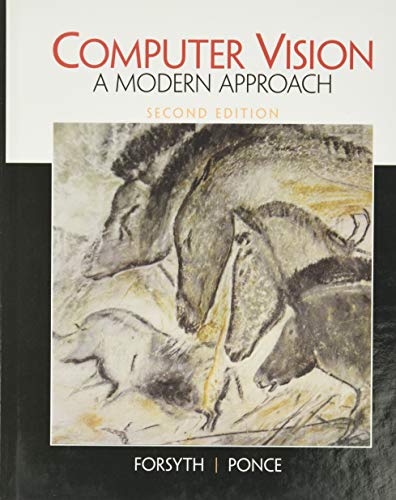
Computer Vision: A Modern Approach by Forsyth and Ponce is a comprehensive textbook covering the mathematical and algorithmic foundations of computer vision. It emphasizes geometric methods, probabilistic models, and practical techniques for image formation, feature extraction, object recognition, and 3D reconstruction. Widely used in advanced undergraduate and graduate courses, it balances theory with implementation insights, making it a standard reference for students and researchers in computer vision and related fields.
This book is not available
Store  |
Condition |
Deals & Coupons | Price |
Est. Shipping |
Total |
Buy |
|---|---|---|---|---|---|---|
| Sorry we could not find any result for “9780136085928” | ||||||
About Computer Vision: A Modern Approach
Computer Vision: A Modern Approach provides a rigorous introduction to the science and engineering of computer vision. The book begins with image formation and processing, then covers feature detection, segmentation, and grouping. It explores geometric vision, including camera models, stereo, and structure from motion, alongside probabilistic and learning-based approaches for recognition. Later chapters address tracking, shape analysis, and applications. Forsyth and Ponce emphasize mathematical foundations and algorithmic thinking, offering pseudocode and exercises that bridge theory and practice. This second edition includes updated material on modern topics such as object recognition and image-based rendering. It is suitable for advanced undergraduates and graduate students in computer science, engineering, and mathematics who seek a deep understanding of how machines interpret visual data.
Who should read Computer Vision: A Modern Approach?
This book is ideal for advanced undergraduate and graduate students in computer science, electrical engineering, and applied mathematics who want a rigorous foundation in computer vision. It suits researchers and practitioners seeking a comprehensive reference on classical and modern techniques. Readers should have background in linear algebra, probability, and basic programming. Instructors will find it well-organized for a semester-long course, while self-learners with strong quantitative skills can use it to build expertise in image analysis, recognition, and 3D reconstruction.
Pros & Cons
Pros
- ✓ Image formation and camera models
- ✓ Feature detection and matching
- ✓ Segmentation and grouping
- ✓ Stereo vision and structure from motion
- ✓ Object recognition and probabilistic models
Similar books


Frequently asked questions
What mathematical background is required?
Readers should be comfortable with linear algebra, multivariable calculus, and basic probability. Some familiarity with algorithms and programming helps, but the book provides sufficient mathematical detail for motivated learners.
Is this book suitable for self-study?
Yes, though it is dense. The exercises and pseudocode support independent learning. Working through the mathematical derivations and implementing algorithms will deepen understanding. It is best suited for readers with a strong quantitative foundation.
Does the book cover deep learning for computer vision?
The second edition includes some modern topics, but deep learning is not the primary focus. It provides a strong foundation in classical methods, which remain relevant. Readers interested in deep learning may need supplementary resources.
What are the main differences between this and Szeliski's book?
Forsyth and Ponce emphasize mathematical rigor and geometric foundations, while Szeliski offers a broader, more application-oriented survey with more coverage of modern learning-based methods. Both are excellent; the choice depends on whether you prefer depth in theory or breadth.
Is this edition up-to-date with current research?
The second edition (2011) covers foundational and some contemporary topics, but computer vision evolves rapidly. It remains a solid reference for core concepts, though readers should consult recent literature for state-of-the-art deep learning techniques.
At Windsorbooks, we compare prices from trusted sellers so you can buy, rent, or sell textbooks at the best total price — shipping included.
As an Amazon Associate, Windsorbooks.com may earn a small commission on qualifying purchases.