
 Wishlist
Book Summary
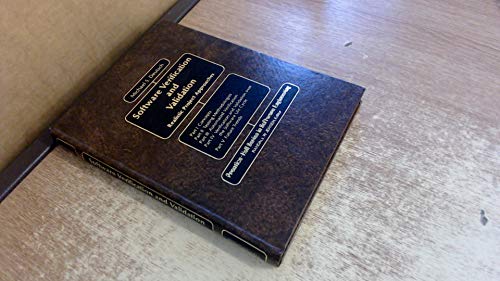
Software Verification and Validation by Deutsch and Willis is a comprehensive textbook covering the principles, techniques, and management of software testing and quality assurance. It provides a rigorous academic foundation for students and professionals, detailing verification methods, validation strategies, and practical frameworks for ensuring software reliability and correctness throughout the development lifecycle.
This book is not available
Store  |
Condition |
Deals & Coupons | Price |
Est. Shipping |
Total |
Buy |
|---|---|---|---|---|---|---|
| Sorry we could not find any result for “9780138220723” | ||||||
About Software Verification and Validatio...
This textbook offers an in-depth exploration of software verification and validation (V&V), emphasizing both theoretical foundations and practical application. It covers key topics such as static and dynamic analysis, testing levels, formal methods, and V&V planning. The authors integrate industry standards and real-world examples to illustrate how to design effective verification and validation processes. Readers will learn to apply techniques for requirements validation, design verification, code inspection, and various testing strategies. The book also addresses management aspects, including metrics, tool support, and process improvement. With its balanced treatment of principles and practice, this text equips readers with the knowledge to systematically assess and improve software quality, making it a valuable resource for academic courses and professional development in software engineering.
Who should read Software Verification and Validatio...?
This book is ideal for undergraduate and graduate students in software engineering or computer science programs, particularly those enrolled in courses on software testing, quality assurance, or verification and validation. It also serves professionals seeking to deepen their understanding of V&V principles and practices, including software engineers, test managers, quality assurance specialists, and project leads. Additionally, researchers and practitioners interested in formal methods and systematic quality improvement will find it a useful reference.
Pros & Cons
Pros
- ✓ Comprehensive coverage of verification and validation principles and techniques
- ✓ Balances theoretical foundations with practical applications and examples
- ✓ Includes discussion of management aspects such as planning and metrics
- ✓ Suitable for both academic study and professional reference
- ✓ Written by experienced authors in the field
Cons
- ✗ May be too theoretical for readers seeking hands-on, tool-specific guidance
- ✗ Some topics may feel dated to practitioners using the latest agile and DevOps practices
- ✗ Lacks extensive case studies or exercises for self-study
- ✗ Assumes prior knowledge of software engineering fundamentals
- ✗ Limited coverage of emerging areas like AI-based testing or continuous validation
Similar books


Frequently asked questions
What is the difference between verification and validation?
Verification checks whether the software is built correctly according to specifications, while validation checks whether the right software is built to meet user needs. This book explains both concepts and their integration.
Is this book suitable for self-study?
Yes, it is written in a clear, instructional style with examples, making it accessible for self-learners with a basic background in software engineering.
Does the book cover agile or DevOps testing?
While the book focuses on fundamental V&V principles, it includes some discussion of process models. However, it may not deeply address the latest agile and DevOps practices.
Are there exercises or case studies included?
The book includes illustrative examples and some end-of-chapter questions, but it is not primarily an exercise workbook. Supplementary materials may be needed for extensive practice.
What prior knowledge is required?
Readers should have a foundational understanding of software engineering concepts, including the software development lifecycle and basic programming.
At Windsorbooks, we compare prices from trusted sellers so you can buy, rent, or sell textbooks at the best total price — shipping included.
As an Amazon Associate, Windsorbooks.com may earn a small commission on qualifying purchases.