
 Wishlist
Book Summary
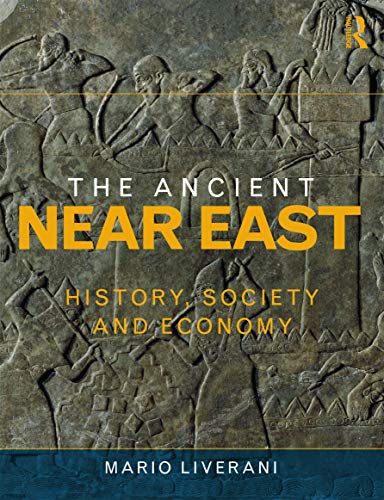
Mario Liverani's 'The Ancient Near East: History, Society and Economy' is a comprehensive scholarly textbook covering the civilizations of Mesopotamia, Egypt, Anatolia, and the Levant from prehistory to the Persian period. It emphasizes social and economic structures alongside political history, drawing on archaeological and textual evidence. This English translation makes a classic Italian synthesis available to students and researchers seeking a rigorous, thematic overview of the region's formative eras.
This book is not available
Store  |
Condition |
Deals & Coupons | Price |
Est. Shipping |
Total |
Buy |
|---|---|---|---|---|---|---|
| Sorry we could not find any result for “9780415679060” | ||||||
About The Ancient Near East: History,...
Mario Liverani's 'The Ancient Near East: History, Society and Economy' is a magisterial textbook that surveys the ancient civilizations of Mesopotamia, Egypt, Anatolia, Syria-Palestine, and Iran from the Neolithic through the Achaemenid period. Originally published in Italian and translated for English-speaking readers, it combines chronological narrative with thematic analysis of social organization, economic systems, political institutions, religion, and law. Liverani draws extensively on cuneiform texts, archaeological evidence, and art-historical sources to reconstruct daily life, state formation, trade networks, and imperial administration. The book is organized both diachronically and thematically, allowing readers to trace long-term developments while exploring specific topics such as urbanization, pastoralism, and scribal culture. Maps, illustrations, and bibliographies support the text. It is widely used in university courses on ancient history and Near Eastern studies, offering a balanced synthesis that moves beyond purely political history to foreground the lived experience of ancient societies.
Who should read The Ancient Near East: History,...?
This book is essential for undergraduate and graduate students in ancient history, archaeology, biblical studies, and Near Eastern languages. It suits instructors seeking a comprehensive course text and researchers needing a reliable synthesis of current scholarship. General readers with a serious interest in early civilizations will find it accessible but demanding. It is particularly valuable for those who want to understand the social and economic foundations of ancient Near Eastern societies, not just dynastic chronology.
Pros & Cons
Pros
- ✓ Authoritative synthesis by a leading scholar of the ancient Near East
- ✓ Integrates social, economic, and political history in a single volume
- ✓ Rich use of primary textual and archaeological evidence
- ✓ Clear thematic organization aids understanding of long-term developments
- ✓ Extensive bibliography and illustrations support further study
Cons
- ✗ Dense academic prose may overwhelm casual readers
- ✗ Assumes some prior knowledge of ancient history and geography
- ✗ Limited coverage of certain regions compared to Mesopotamia and Egypt
- ✗ Translation occasionally feels stilted or formal
- ✗ Some topics may feel dated relative to the latest specialized research
Similar books


Frequently asked questions
Is this book suitable for beginners?
It is best suited to readers with some background in ancient history. Beginners may find the density challenging, but the thematic chapters and glossary can help. It is commonly used in university courses, so motivated general readers can succeed with patience.
Does the book cover Egypt as well as Mesopotamia?
Yes, it includes Egypt alongside Mesopotamia, Anatolia, the Levant, and Iran, though the emphasis varies by period. Egypt is integrated into broader regional discussions rather than treated in isolation.
What period does the book cover?
It spans from the Neolithic and early urban cultures through the Achaemenid Persian period, roughly the tenth millennium BCE to the fourth century BCE, with a focus on the Bronze and Iron Ages.
Is this an updated edition?
The English translation (Routledge, 2014) is based on the revised Italian edition and includes updated bibliographies. It remains a standard reference, though specialized research continues to evolve.
Does it include maps and illustrations?
Yes, the book contains maps, plans, and photographic illustrations that support the text, along with suggestions for further reading at the end of chapters.
At Windsorbooks, we compare prices from trusted sellers so you can buy, rent, or sell textbooks at the best total price — shipping included.
As an Amazon Associate, Windsorbooks.com may earn a small commission on qualifying purchases.