
 Wishlist
Book Summary
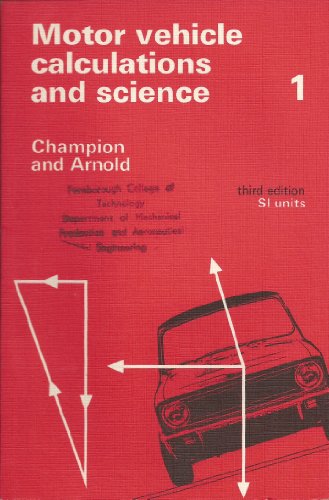
Motor Vehicle Calculations and... by Champion and Arnold is a technical textbook that teaches the mathematical principles behind automotive engineering. It covers calculations for engine performance, braking, suspension, and electrical systems, providing worked examples and practice problems. Ideal for students and apprentices in motor vehicle courses, this book bridges theory and practical application, helping readers develop the numerical skills needed for diagnostics, design, and maintenance in the automotive industry.
This book is not available
Store  |
Condition |
Deals & Coupons | Price |
Est. Shipping |
Total |
Buy |
|---|---|---|---|---|---|---|
| Sorry we could not find any result for “9780713132304” | ||||||
About Motor Vehicle Calculations and...
Motor Vehicle Calculations and... is a comprehensive textbook designed for students of automotive engineering and vehicle maintenance. Authored by Champion and Arnold, it focuses on the mathematical calculations essential to understanding how vehicles work. The book covers a wide range of topics, including engine displacement, power and torque, fuel consumption, braking efficiency, suspension geometry, and electrical circuit analysis. Each chapter introduces key formulas, explains their real-world applications, and provides worked examples followed by practice exercises. This approach helps learners build confidence in applying mathematics to automotive problems. Whether used in a classroom setting or for self-study, the text supports vocational courses and apprenticeships by linking theoretical concepts to practical tasks. It is an invaluable resource for anyone seeking to deepen their technical knowledge of motor vehicles.
Who should read Motor Vehicle Calculations and...?
This book is ideal for students enrolled in automotive engineering or motor vehicle maintenance courses at technical colleges and vocational schools. Apprentices working toward qualifications in vehicle repair and technology will find it indispensable for understanding the calculations behind everyday tasks. It also suits practicing technicians who want to refresh their mathematical skills or prepare for advanced diagnostics. Additionally, hobbyists and car enthusiasts with a technical bent will appreciate the clear explanations of automotive principles. Instructors can use it as a course companion, and anyone pursuing further study in mechanical engineering with a focus on vehicles will benefit from its practical approach.
Pros & Cons
Pros
- ✓ Clear explanations of complex automotive calculations with step-by-step worked examples.
- ✓ Covers a broad range of topics from engine performance to electrical systems.
- ✓ Practice exercises reinforce learning and build problem-solving confidence.
- ✓ Directly applicable to vocational courses and apprenticeships in motor vehicle technology.
- ✓ Written by experienced authors in the field, ensuring accuracy and relevance.
Cons
- ✗ Some readers may find the mathematical content challenging without prior basic algebra knowledge.
- ✗ The book may not cover the latest hybrid and electric vehicle technologies in depth.
- ✗ Lacks a detailed description, so buyers should verify the edition and contents.
- ✗ Could benefit from more real-world case studies and diagnostic scenarios.
- ✗ Illustrations may be limited, requiring supplemental visual resources for some topics.
Similar books


Frequently asked questions
What topics are covered in Motor Vehicle Calculations and...?
The book covers mathematical calculations related to engine performance, braking systems, suspension, steering, electrical circuits, fuel consumption, and vehicle dynamics, with worked examples and exercises.
Is this book suitable for beginners?
It is aimed at students and apprentices with some basic mathematical background. While it explains concepts clearly, readers may need a grasp of elementary algebra to fully benefit.
Does the book include practice problems?
Yes, each chapter typically includes worked examples followed by practice exercises to reinforce learning and allow readers to test their understanding.
Is this book up to date with modern vehicle technology?
The book focuses on fundamental principles that remain relevant, but it may not cover the latest hybrid and electric vehicle systems in detail. It is best used as a foundation.
Can this book be used for self-study?
Absolutely. The clear explanations and practice problems make it suitable for independent learners, though it is also widely used in formal automotive courses.
At Windsorbooks, we compare prices from trusted sellers so you can buy, rent, or sell textbooks at the best total price — shipping included.
As an Amazon Associate, Windsorbooks.com may earn a small commission on qualifying purchases.