
 Wishlist
Book Summary
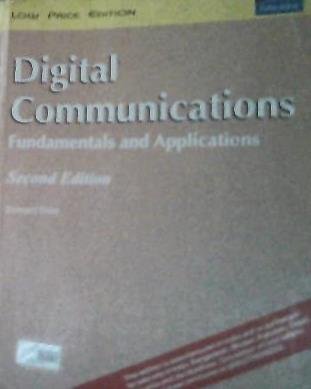
Bernard Sklar's Digital Communications: Fundamentals and Applications is a cornerstone textbook that bridges theory and practice in digital communication systems. It covers signal processing, modulation, coding, and spread spectrum with clear explanations and real-world examples. Ideal for students and engineers seeking a solid foundation in modern communication techniques.
This book is not available
Store  |
Condition |
Deals & Coupons | Price |
Est. Shipping |
Total |
Buy |
|---|---|---|---|---|---|---|
| Sorry we could not find any result for “9788177584400” | ||||||
About Digital Communications; Fundamental...
Digital Communications: Fundamentals and Applications by Bernard Sklar is a comprehensive textbook that introduces the fundamental principles of digital communication systems. It covers topics such as signals and spectra, formatting and baseband modulation, bandpass modulation and demodulation, channel coding, and spread spectrum. The book emphasizes both theoretical concepts and practical applications, providing worked examples and MATLAB exercises. It is widely used in undergraduate and graduate courses and serves as a valuable reference for practicing engineers. The clear writing style and structured approach make complex topics accessible, helping readers design and analyze digital communication systems effectively.
Who should read Digital Communications; Fundamental...?
This book is ideal for undergraduate and graduate students in electrical engineering, computer science, and telecommunications. It also suits practicing engineers seeking to refresh or deepen their understanding of digital communications. Instructors can use it as a course text, and self-learners will find the clear explanations and examples helpful. Professionals working on wireless systems, modem design, or network infrastructure will benefit from the practical insights and mathematical foundations provided.
Pros & Cons
Pros
- ✓ Clear and accessible explanations of complex topics
- ✓ Comprehensive coverage of digital communication fundamentals
- ✓ Includes practical examples and MATLAB exercises
- ✓ Well-structured for both self-study and classroom use
- ✓ Authoritative and widely respected in the field
Cons
- ✗ Some sections may be mathematically dense for beginners
- ✗ Lacks coverage of latest advanced topics like 5G
- ✗ Examples sometimes assume prior knowledge of signals and systems
- ✗ No solutions manual included for all exercises
- ✗ International edition may have different formatting
Similar books


Frequently asked questions
Is this book suitable for self-study?
Yes, the book is written in a clear, tutorial style with numerous examples and exercises, making it suitable for self-study, though some background in signals and systems is helpful.
Does it cover error correction coding?
Yes, it includes thorough coverage of channel coding, including block codes, convolutional codes, and turbo codes.
What edition is this?
This is the international edition of the second edition, ISBN 9788177584400, which is widely used in many countries.
Are there MATLAB exercises?
Yes, the book incorporates MATLAB exercises and examples to help readers simulate and analyze communication systems.
Is it up-to-date with modern standards?
While it covers fundamental principles that remain relevant, it does not include the latest standards like 5G; it focuses on core concepts applicable across generations.
At Windsorbooks, we compare prices from trusted sellers so you can buy, rent, or sell textbooks at the best total price — shipping included.
As an Amazon Associate, Windsorbooks.com may earn a small commission on qualifying purchases.