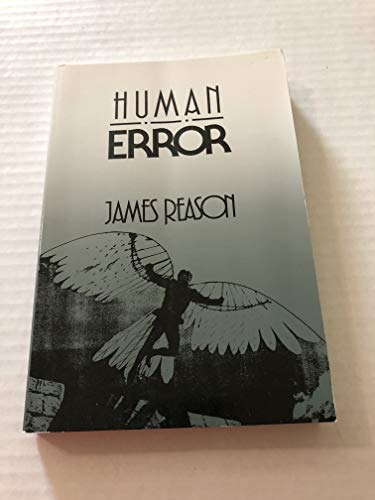
Human Error

Human Error

Publisher
Cambridge University Press
Published
1990
Pages
302
ISBN-13
9780521314190
Format
print
Language
English

Human Error, published in 1991, is a major theoretical integration of several previously isolated literatures. Particularly important is the identification of cognitive processes …

Book Summary
James Reason's Human Error (1991) is a foundational text that integrates psychological theory with reliability engineering. It identifies cognitive processes behind various error types and explains how understanding these mechanisms is essential for improving safety in hazardous technologies. Essential for cognitive scientists, human factors specialists, reliability engineers, and risk managers seeking a clear bridge between theory and practice.
This book is not available
Best buying and renting options — totals include estimated shipping when seller shipping is unavailable
Store Condition Deals & Coupons Price Est. Shipping Total Buy
About Human Error

Human Error, published in 1991, is a major theoretical integration of previously isolated literatures on human fallibility. James Reason identifies cognitive processes common to a wide variety of error types, offering a unified framework for understanding why humans make mistakes. The book argues that technology has reached a point where further safety improvements depend on better comprehension of human error mechanisms. In its treatment of major accidents, it spans the disciplinary gulf between psychological theory and the concerns of those maintaining hazardous technologies. As such, it speaks with exceptional clarity to both theorists and practitioners of human reliability, making it essential reading for cognitive scientists, human factors specialists, reliability engineers, and risk managers.

Who should read Human Error?

This book is essential for cognitive scientists, human factors specialists, reliability engineers, and risk managers. It is also valuable for graduate students and researchers in psychology, ergonomics, and safety engineering. Practitioners in hazardous industries—such as aviation, nuclear power, and healthcare—will benefit from its practical insights into error mechanisms. Anyone seeking a rigorous yet accessible bridge between psychological theory and real-world safety applications will find this text indispensable.

Pros & Cons
Pros
  • ✓ Provides a unified theoretical framework for understanding human error across disciplines
  • ✓ Bridges the gap between psychological theory and practical reliability engineering
  • ✓ Offers clear, insightful analysis of major accidents and their cognitive underpinnings
  • ✓ Written by a leading authority, James Reason, with exceptional clarity
  • ✓ Essential reading for both theorists and practitioners in human reliability
Cons
  • ✗ Some content may feel dated as it was published in 1991
  • ✗ Dense theoretical sections may challenge readers without a psychology background
  • ✗ Limited coverage of modern technological developments since publication
  • ✗ Focuses heavily on cognitive processes, with less emphasis on organizational factors
  • ✗ Examples and case studies are primarily from the pre-1991 era
Frequently asked questions
Is Human Error still relevant today?
Yes, its core principles about cognitive error mechanisms remain foundational in human factors and safety engineering, though readers should supplement with newer works for contemporary examples.
What is the main thesis of the book?
The book argues that improved safety in hazardous technologies requires a deep understanding of human error mechanisms, integrating psychological theory with practical reliability concerns.
Who is James Reason?
James Reason is a renowned psychologist and professor emeritus at the University of Manchester, known for his pioneering work on human error and organizational accidents.
Does the book cover both theory and practice?
Yes, it explicitly bridges the gap between psychological theory and the practical concerns of maintaining reliability in hazardous technologies.
Is this book suitable for beginners?
It is accessible to graduate students and professionals, but some background in psychology or engineering may help. It is not an introductory text for complete novices.

At Windsorbooks, we compare prices from trusted sellers so you can buy, rent, or sell textbooks at the best total price — shipping included.

As an Amazon Associate, Windsorbooks.com may earn a small commission on qualifying purchases.