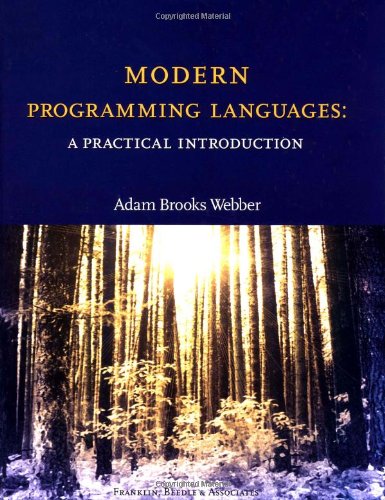
Modern Programming Languages: A...
 Wishlist
Intended for computer science majors, this textbook introduces the abstract concepts that underlie all programming languages, and provides tutorials on ML, Java, and Prolog. Webbe…

Intended for computer science majors, this textbook introduces the abstract concepts that underlie all programming languages, and provides tutorials on ML, Java, and Prolog. Webbe…
Store  |
Condition |
Deals & Coupons | Price |
Est. Shipping |
Total |
Buy |
|---|---|---|---|---|---|---|
| Sorry we could not find any result for “9781887902762” | ||||||
Modern Programming Languages: A Practical Introduction by Adam Brooks Webber is designed for computer science majors seeking a deep understanding of programming language principles. The book introduces fundamental concepts such as grammar, syntax, semantics, language systems, types, and polymorphism, which are common to all programming languages. Rather than focusing on a single language, it teaches students how to analyze and compare languages, making them adaptable to new technologies. The text includes hands-on tutorials on ML, Java, and Prolog, illustrating different programming paradigms—functional, object-oriented, and logic programming. Webber, a professor at the University of Wisconsin, combines theoretical foundations with practical examples, enabling readers to grasp abstract ideas through concrete implementations. This approach equips students with the skills to evaluate language features, understand design trade-offs, and become more effective programmers. The book is suitable for a one- or two-semester course and serves as a valuable reference for anyone interested in the theory and practice of programming languages.
This book is ideal for undergraduate or graduate computer science students enrolled in a programming languages course. It suits learners who already have basic programming experience and want to understand the underlying principles of language design and implementation. Instructors seeking a textbook that balances theory with practical tutorials will find it valuable. Additionally, software engineers and developers looking to deepen their knowledge of language concepts, or those preparing for technical interviews that test language fundamentals, will benefit from this comprehensive resource.
At Windsorbooks, we compare prices from trusted sellers so you can buy, rent, or sell textbooks at the best total price — shipping included.
As an Amazon Associate, Windsorbooks.com may earn a small commission on qualifying purchases.


