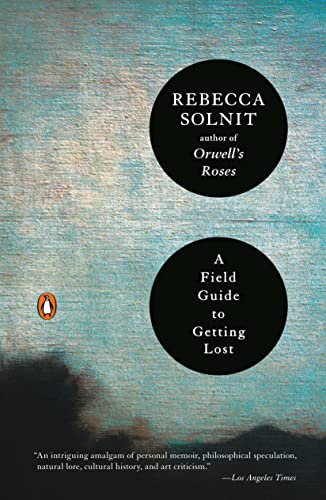
A Field Guide to Getting Lost
 Wishlist
A series of autobiographical essays draws on key moments and relationships in the author's life to explore such issues as trust, loss, and desire, in a volume that focuses on a ce…

A series of autobiographical essays draws on key moments and relationships in the author's life to explore such issues as trust, loss, and desire, in a volume that focuses on a ce…
Store  |
Condition |
Deals & Coupons | Price |
Est. Shipping |
Total |
Buy |
|---|---|---|---|---|---|---|
| Sorry we could not find any result for “9780143037248” | ||||||
In A Field Guide to Getting Lost, Rebecca Solnit weaves together memoir, history, and philosophy to examine the value of losing one's way. Across nine essays, she ranges from the deserts of the American West to the streets of Paris, from the paintings of Yves Klein to the letters of Virginia Woolf. Solnit explores how getting lost—whether geographically, emotionally, or intellectually—can open us to new ways of seeing and being. She distinguishes between the terror of being lost and the deliberate act of losing oneself, arguing that the latter is essential for creativity, empathy, and growth. The book is less a guide than a companion for anyone willing to wander.
This book is for readers who enjoy literary essays, memoir, and philosophical reflection. It suits artists, writers, and creative thinkers seeking inspiration from uncertainty. Travelers and wanderers—both literal and metaphorical—will appreciate Solnit's meditations on place and displacement. Anyone navigating a life transition, grappling with loss, or questioning the pressure to always know where they're going will find solace here. It is also valuable for students of cultural history, environmental writing, and feminist thought.
At Windsorbooks, we compare prices from trusted sellers so you can buy, rent, or sell textbooks at the best total price — shipping included.
As an Amazon Associate, Windsorbooks.com may earn a small commission on qualifying purchases.


